

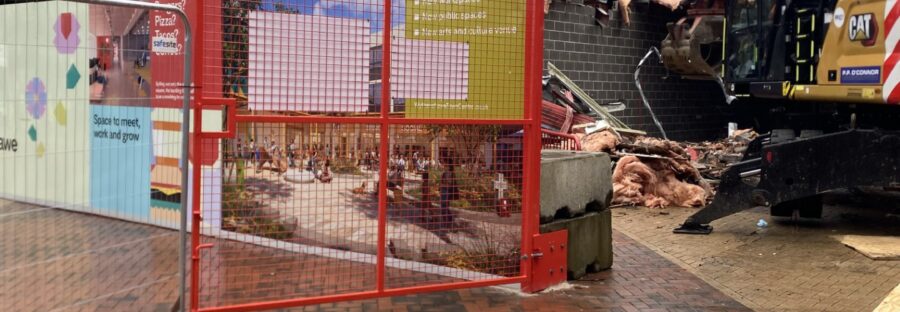
Ground breaks on the Wythenshawe regeneration project
Wythenshawe town centre is set for a £500m, 10–15‑year transformation that will deliver 2,000 new homes, revamped public spaces and a pioneering low‑carbon “positive energy district”.
The first phase is now under way, with planners promising not just bricks and mortar but a redesigned civic heart aimed at cutting bills, tackling loneliness and keeping young people in the area.
Of the 2,000 homes planned, 422 will be let at social rent levels in the opening phase, after shared ownership options were dropped because they no longer stacked up financially.
Andrea Lowman, Executive Director of Development at Wythenshawe Community Housing Group (WCHG), said rising construction costs had made shared ownership unviable for now. “We were hoping to include some shared ownership for mixed tenure, but unfortunately the cost‑to‑value isn’t working,” she said. “It’s costing more for developers to build them than it would be to sell them.”
Instead, WCHG is concentrating on homes at the lowest‑cost tenure, with rents pegged to local authority benchmarks and typical affordability thresholds.
“There’s a real tension for people in low‑paid or part‑time jobs,” Lowman said. “More often than not, it’s people in work or single‑parent families who are struggling most with affordability. We usually base rent on being no more than 30 to 35 per cent of household income.”
Lowman said the housing mix had been shaped by extensive consultation and data analysis, including Manchester’s housing waiting list, census statistics and direct conversations with residents. Community feedback has pushed youth space and culture higher up the agenda, shifting plans beyond a traditional shopping‑and‑food‑led civic centre.
Proposals now include areas for music making, creative activity and the potential for a Saturday‑morning cinema to give young people reasons to spend time in the town centre rather than drifting elsewhere.
The environmental side of the scheme draws on the European Union’s “positive energy district” framework, which aims to ensure neighbourhoods generate as much or more energy than they consume over a year. While cities such as Strabane in Northern Ireland have explored similar ideas, Wythenshawe is being positioned as one of the first UK towns to embed this at scale across a town‑centre regeneration.
A recently-built Datum data centre nearby will be plugged into the local energy system, with waste heat captured and fed into a new district heat network serving the homes.
Residents are being promised lower, more stable energy bills as the network develops. “The idea is that the district doesn’t pull any more energy from the grid than it captures through usage,” Lowman said. “That could be really positive for people in Wythenshawe in terms of lower bills.”
Designers have also tried to hard‑wire social contact into the masterplan, particularly for older residents who reported acute isolation during the Covid‑19 lockdowns. Developments will include shared courtyards, “dwell spaces” and walkable routes intended to encourage everyday encounters while maintaining privacy and security.
At Alpha House, a scheme for over‑55s, a secure communal courtyard has been built in to offer outdoor space without leaving residents feeling exposed.
“Intergenerational stuff is so important in Wythenshawe,” Lowman said. “It’s a community that thrives on those family connections.” She said a significant slice of first‑phase funding had been earmarked for placemaking across the civic area, with public spaces and routes designed to help neighbours see more of one another – and less of their bills.